When you receive a new server rack, you are often faced with a choice during the assembly phase: do you install the casters (wheels) or the leveling feet (fixed legs)?
While wheels make it easy to move the rack for cleaning or cable management, leveling feet provide the stability needed for heavy enterprise equipment. In this guide, we will look at the pros and cons of each and explain why many professionals actually use both at the same time.
Casters (The Mobility Option)
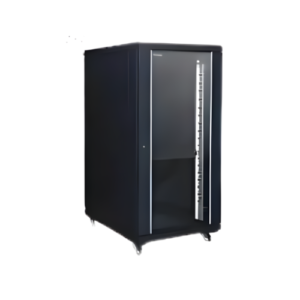
Casters are high-durability wheels that allow you to roll the rack around the room.
-
Pros:
-
Easy Maintenance: You can pull the rack away from the wall to reach the rear cables.
-
Installation: You can populate the rack in a workspace and then roll it into its final location.
-
-
Cons:
-
Vibration: Wheels can sometimes vibrate, which isn’t ideal for traditional spinning hard drives.
-
Weight Limits: Casters have lower weight ratings than solid feet. Overloading them can cause the wheels to “flat-spot” or collapse.
-
Safety Hazard: If the floor isn’t perfectly level, a rack on wheels can slowly “drift” or roll away.
-
Leveling Feet (The Stability Option)
Leveling feet are threaded metal legs with a flat base. They are designed to be screwed in or out to ensure the rack is perfectly vertical.
-
Pros:
-
High Weight Capacity: They can support much heavier loads because the weight is distributed directly into the floor.
-
Precision: If your floor is uneven (common in basements or old buildings), you can adjust each foot individually to ensure the rack doesn’t lean.
-
Earthquake Safety: A rack on feet is much less likely to tip or slide during a seismic event.
-
-
Cons:
-
Zero Mobility: Once the rack is on its feet and loaded with gear, it is permanently stuck there. You cannot move it without a specialized “Rack Lift” or by unloading every server.
-
The Professional Choice: Using Both Together
Most high-end server cabinets come with both casters and leveling feet installed. This is the Hybrid Strategy.
-
Transport: You use the casters to roll the empty rack into position.
-
Deployment: Once the rack is in place, you screw down the leveling feet until they lift the weight of the rack off the wheels.
-
Stability: The rack now sits firmly on the fixed feet, but the wheels remain tucked underneath. If you ever need to move the rack, you simply screw the feet back up and the rack is on wheels again.
Key Considerations for Mobility
Floor Surface
-
Hardwood/Tile: Standard hard casters can scratch or crack tiles. Look for “Non-marking” rubber casters.
-
Carpet: Wheels are very difficult to roll on carpet when under a heavy load. If you have carpet, leveling feet are almost always better.
Center of Gravity
As we discussed in previous articles, always keep your heaviest equipment (UPS and Batteries) at the bottom. This is especially critical when using wheels. A top-heavy rack on wheels is a “tipping disaster” waiting to happen if it hits a small bump in the floor.
Weight Ratings (Static vs. Dynamic)
-
Static Load: The weight the rack can hold when it is sitting still on its feet.
-
Dynamic Load: The weight the rack can safely hold while it is being rolled on its wheels.
-
The Rule: The dynamic load rating is always significantly lower. Never roll a “maxed out” rack unless the casters are specifically rated for that weight.
Summary Comparison
| Feature | Casters (Wheels) | Leveling Feet |
| Primary Goal | Movement and Convenience | Stability and Safety |
| Weight Capacity | Medium | Extreme |
| Installation | Quick | Requires adjustment/leveling |
| Vibration | Higher | Lower |
If your server room has a perfectly level, professional floor, casters offer great convenience. However, for 99% of installations, leveling feet are the safer choice. They ensure your rack is stable, level, and capable of holding the thousands of pounds of hardware that your business relies on.
Experience Tip: Before you load your servers, use a “Bubble Level” on the side of the rack. If the rack is leaning even slightly, it puts extra stress on the server rails and can make sliding servers in and out very difficult. Adjust your leveling feet until the bubble is perfectly centered.