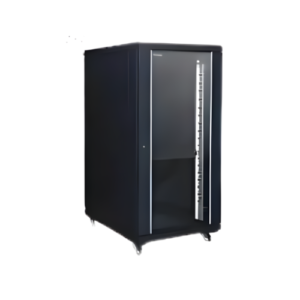
If you walk into a standard office IT room, every rack you see will likely be the same width. However, if you step into a massive telecommunications hub or an older ISP (Internet Service Provider) facility, the racks suddenly look “wider.”
In the world of infrastructure, size isn’t just about how much gear you can fit; it’s about industry standards. The two most common standards are the 19-inch rack and the 23-inch rack. In this guide, we’ll explain where these sizes came from and which one you should be using for your equipment.
1. The 19-Inch Rack: The Global IT Standard
The 19-inch rack is the “universal” standard for almost all server, storage, and networking hardware. When a company like Dell or Cisco builds a device, they build it to fit this specific width.
-
What it measures: The “19 inches” refers to the width of the front panel of the equipment, including the “ears” (the mounting flanges). The actual body of the server is usually around 17.75 inches.
-
Origins: This standard was originally created for railroad signaling but was adopted by the EIA (Electronic Industries Alliance) for electronics.
-
Best For: Servers, UPS systems, storage arrays, and standard office networking.
2. The 23-Inch Rack: The Telecom Specialist
The 23-inch rack is common in the telecommunications industry. If you look at equipment used by mobile phone towers, fiber optic hubs, or traditional telephone exchanges, you will find this wider standard.
-
What it measures: Just like the 19-inch version, the “23 inches” refers to the width across the front mounting face.
-
Why it exists: Telecom equipment often requires more internal space for complex wiring, heat dissipation, and larger circuit boards. The extra 4 inches of width provides significantly more room for high-density fiber management.
-
Best For: Fiber optic terminations, telephone switching gear, and specialized ISP equipment.
3. Key Differences at a Glance
| Feature | 19-Inch Rack | 23-Inch Rack |
| Primary Industry | IT, Computing, Data Centers | Telecommunications, ISP, Telco |
| Availability | Extremely High (Common) | Lower (Specialized) |
| Component Support | Thousands of server brands | Limited specialized telecom brands |
| Mounting Style | Mostly 4-post (for depth) | Mostly 2-post (for accessibility) |
4. The “Hole” Difference: Western Electric vs. EIA
It’s not just the width that changes; the way equipment is bolted in can vary too.
-
EIA Standard (Wide/Narrow): Used in most 19-inch racks. The holes are spaced in a repeating pattern (5/8″ – 5/8″ – 1/2″). This is designed to accommodate the “Rack Unit (U)” system.
-
Western Electric Standard (Even): Often found in 23-inch telecom racks. The holes are spaced evenly (1 inch apart).
-
Warning: You cannot always bolt 19-inch “U-based” gear into a 23-inch “WE-based” rack without special adapter brackets.
5. Can I Use a 19-inch Server in a 23-inch Rack?
Yes, but you need Rack Adapters.
These are metal brackets that “bridge the gap” between the 23-inch rails and the 19-inch server ears.
-
When to do this: If you are renting space in a telecom data center that only provides 23-inch racks, you will need these adapters to mount your standard IT servers.
-
When NOT to do this: If you are building a new office, never buy a 23-inch rack for standard servers. It makes cable management much more difficult and creates “dead space” on the sides of your equipment.
6. Depth: The Hidden Standard
While the width is standardized at 19 or 23 inches, the depth is not.
-
Networking Racks: Usually 600mm to 800mm deep.
-
Server Racks: Usually 1000mm to 1200mm deep.
Always ensure your rack is deep enough for your equipment, regardless of which width you choose.
For 99% of modern business applications, the 19-inch rack is the correct choice. It offers the most compatibility, the best prices, and the widest range of accessories. However, if your business is expanding into fiber-to-the-home (FTTH) or cellular infrastructure, you’ll likely encounter the 23-inch giant. Knowing the difference ensures you don’t buy gear that simply won’t bolt into your rails.
Experience Tip: Always check the “Mounting Center-to-Center” distance. In a 19-inch rack, the distance between the center of the holes on the left and right rails is exactly 18.31 inches. If your server ears don’t align with that, you have a non-standard rack!
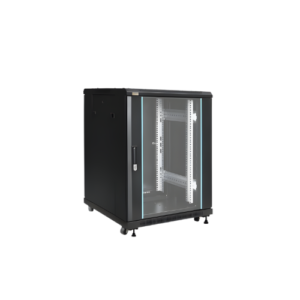
15U Server Rack
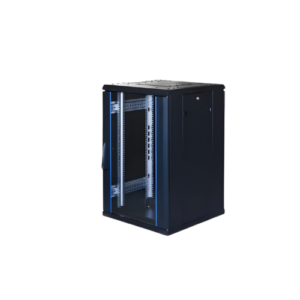
18U Server Rack
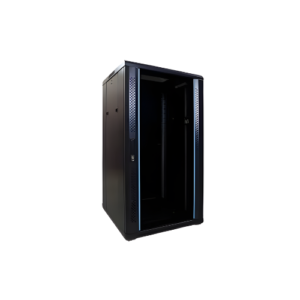
22U Server Rack